
A free interactive study app for senior Drama and Theatre Studies students
The Poor Theatre Learning Lab is a free interactive web-based educational tool designed for senior Drama and Theatre Studies students exploring the practice and influence of Jerzy Grotowski. It invites students to investigate his ideas about actor training, theatrical necessity, and the live actor-spectator encounter in a practical, visual, and intellectually rigorous manner. The app combines substantial theory with active learning tasks so students can build understanding through doing as well as reading.
The app is organised as a guided sequence of Poor Theatre learning modules, beginning with Grotowski’s biography and moving through the following key areas:
- Origins of the Laboratory Theatre
- Poor Theatre
- Gloassary of Key Terms
- Objects and Text
- Via Negativa
- Holy Actor
- Plastiques
- Voice Score
- Space and Audience
- Case Studies
- Ethics
- Paratheatre
- Legacy
- Devising lab
One of the app’s strongest features is the depth of its core theory content. Every module includes substantial paragraph-based theory written specifically for senior secondary learners. These sections explain Grotowski’s concepts in a way that is suitable for serious classroom study, introducing key terminology, historical context, and the relationship between an artistic question and a theatrical choice. Students encounter terms such as poor theatre, via negativa, holy actor, total act, score, psychophysical action, and paratheatre alongside examples that keep the vocabulary connected to rehearsal, performance, and classroom practice.
This makes the app useful for independent review, explicit teaching, close reading, note-making, and class discussion.
Varied Activities
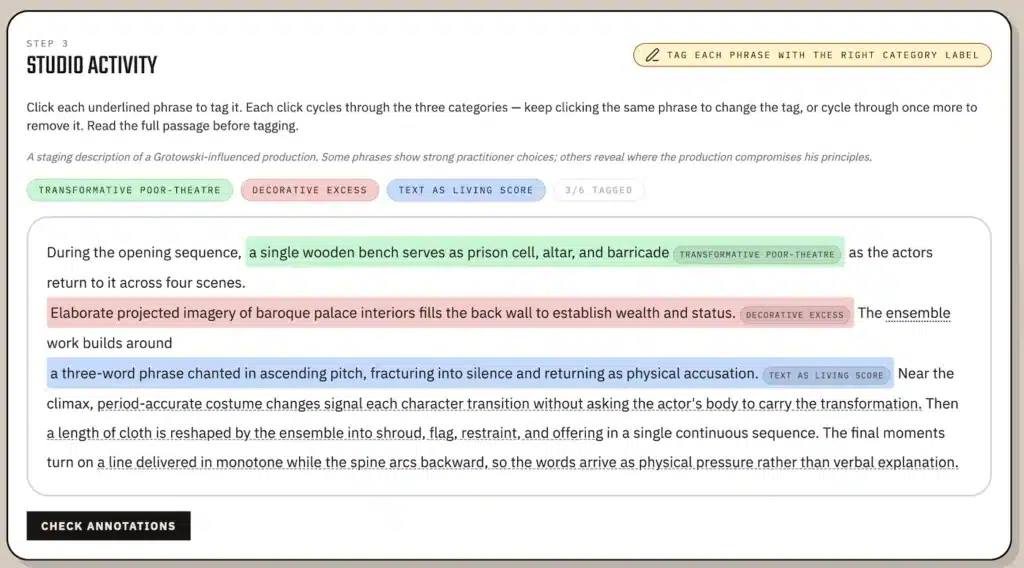
What makes the Poor Theatre Learning Lab especially engaging is the range of activity types built into the modules. Each activity is matched carefully to the concept being studied. In Origins, students predict whether each statement describes historical context, a training influence, or company development, then flip each card to reveal an explanation. In the Poor Theatre module, a continuum asks learners to position directorial choices between spectacle-led theatre and poor-theatre rigour. They must judge how a cloth, a seating arrangement, a realistic set, a costume change, or the actor’s voice affects theatrical necessity and the audience’s imagination.
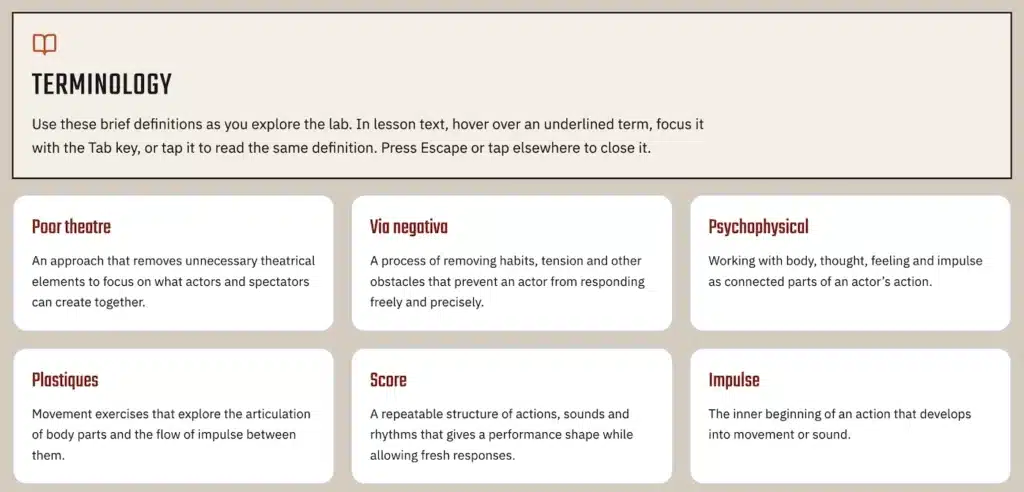
The Via Negativa module turns theory into rehearsal diagnosis. Students match common problems—decorative gesture, muscular tension, self-monitoring, explanatory delivery, or emotional forcing—with a practical response that removes the obstacle. In the Holy Actor activity, a scenario-based directing choice asks students to select the note that develops a precise score and committed performance while respecting performer boundaries. These tasks ask students to analyse, compare, justify, and interpret rather than simply recall facts.
The app also includes extension prompts that carry the learning beyond the screen. Students can explain why ‘laboratory’ is more useful than ‘style’, redesign a familiar scene using poor-theatre principles, rewrite generic acting notes into sharper Via Negativa instructions, or write a teacher-facing explanation of ‘total act’ as Grotowski intended. The feedback panels make the process visible: students can see their accuracy, review explanatory notes, and try again.
Theory and Practice
Senior students will also benefit from the app’s close connection between Grotowski’s theory and practice. Each module asks learners to move from reading to applying. The biography establishes the Polish post-war context, the Theatre of 13 Rows, the Laboratory Theatre, and the later movement towards paratheatre and the Workcenter. The Origins module then separates historical conditions from training influences such as Stanislavski’s method of physical actions and Meyerhold’s biomechanics, giving students a clearer foundation for analysis.
The Poor Theatre module becomes a design investigation into subtraction, object transformation, and the actor-spectator relationship. Via Negativa becomes a set of precise rehearsal interventions. Plastiques and Voice Score connect disciplined physical and vocal training to repeatable action, while the Space and Audience module asks students to treat architecture, pathways, and proximity as dramaturgical choices. The Case Studies module tests these ideas against Grotowski’s productions, including Akropolis, The Constant Prince, and Apocalypsis Cum Figuris. The Ethics module ensures that high-intensity practice is translated into safe, teachable ensemble systems, and the final Devising Lab area invites students to synthesise the discoveries into a rehearsal-ready performance proposal.
The visual design also contributes powerfully to learning. Track filters, progress indicators, sticky navigation, clear mission numbers, and distinctive page headers help students stay oriented across the thirteen-module route. The four research tracks—Stripped Stage, Psychophysical Score, Encounter Architecture, and Beyond Production—allow learners to follow the recommended sequence or focus on a related group of ideas. Because each module has its own activity focus and visual identity, the experience feels purposeful and varied. Students can concentrate on the content instead of working out where they are or what they are meant to do next.
Senior Drama and Theatre Students
The Poor Theatre Learning Lab is especially well-suited to senior Drama and Theatre classes because it treats students as developing theatre-makers rather than just content consumers. It asks them to think like directors, actors, designers, and critics. It builds analytical vocabulary, sharpens interpretive judgement, and encourages students to consider how Grotowski’s demanding ideas can be adapted into responsible contemporary practice. The emphasis on boundaries, consent, precision, and repeatable scores gives students a constructive way to discuss risk without confusing distress with artistic truth.
For teachers and students studying Jerzy Grotowski and Poor Theatre, this app provides a dynamic digital learning environment that is both accessible and challenging. It helps students understand not only what Poor Theatre is, but also how it works, why actor training matters, how spectatorship becomes part of the form, and how Grotowski’s ideas can be applied through thoughtful real-world drama practice.
Whether it is used for classwork, revision, flipped learning, or preparation for devising, the Poor Theatre Learning Lab app offers a strong combination of academic rigour, interactivity, and creative possibilities. Students can move from a timeline or quotation to a staging decision, a rehearsal note, a spatial experiment, or an assessment-ready explanation. That movement between theory and action is where the app becomes most valuable.
Leave a Reply