The World Theatre Atlas, below, will reveal that theatre is not a singular tradition; rather, it has been practised simultaneously in diverse contexts around the world, including temple rituals in Kerala, open-air festivals in Athens, court performances in Kyoto, carnival processions in Port of Spain, political agitprop in Berlin, and numerous other locations. Recognising theatre as a genuinely global practice—rather than merely a European export with occasional regional variations—represents a significant shift in how the discipline is now taught and understood. The World Theatre Atlas has been developed to illuminate this broader perspective.
Presented below is an interactive tool that maps 783 theatre practitioners, traditions, companies, productions, and locations on a three-dimensional globe. Users can rotate the globe, zoom in and out, and select any pin to display a detailed information card. Ten distinct data categories are available for exploration, each representing a unique strand within the global narrative of theatre.
What the Atlas Contains
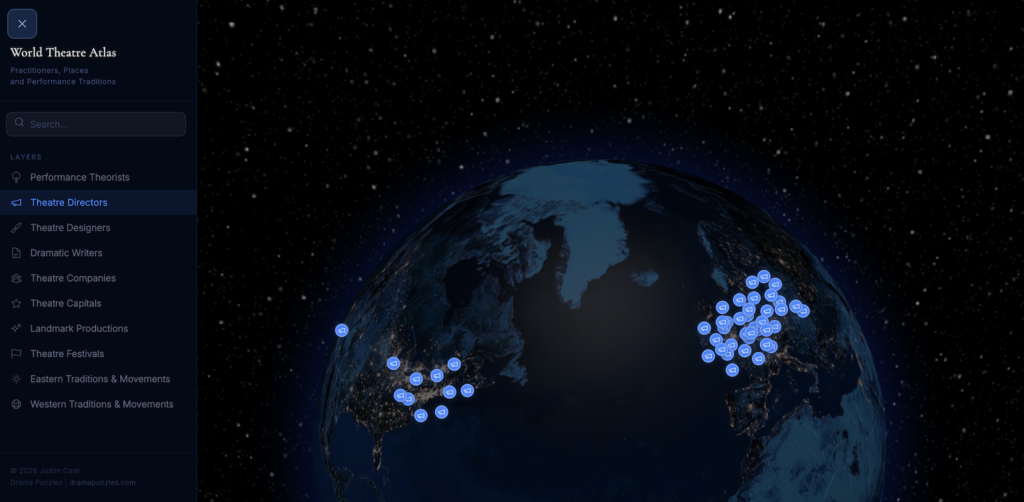
The atlas is divided into ten categories, which you can select from the sidebar. Each category drops coloured pins at locations around the world, often clustering when several entries share the same city.
Performance Theorists maps 21 foundational figures — from Stanislavsky in Moscow and Grotowski in Wrocław to Boal in Rio de Janeiro, Suzuki in Toga, and Spolin in Chicago — each with a biographical card explaining their method and its lasting influence.
Theatre Directors charts 56 significant directors whose work shaped modern production practice across Europe, the Americas, Asia, and Africa.
Theatre Designers locates 94 designers by their place of birth, covering scenic, costume, lighting, and sound design, from Gordon Craig and Adolphe Appia to contemporary figures such as Es Devlin and David Korins.
Dramatic Writers places 178 playwrights at the cities most closely associated with their work, spanning ancient Athens, Elizabethan London, Meiji-era Tokyo, twentieth-century New York, and postcolonial Nairobi.
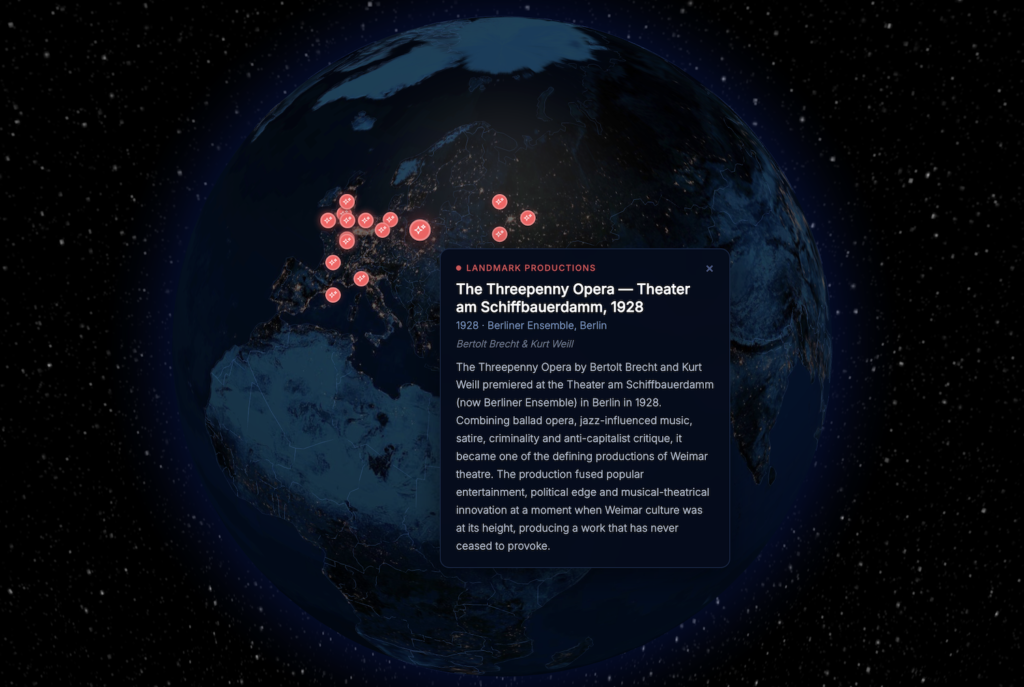
Theatre Companies and Landmark Productions document significant institutional and production histories, while Theatre Festivals and Theatre Capitals chart the geography of where theatre has concentrated its energy across different periods.
Eastern Traditions & Movements and Western Traditions & Movements together include 146 entries, covering everything from Nō, Kathakali, Wayang Kulit, and Karagöz to Greek tragedy, Commedia dell’Arte, Epic Theatre, Theatre of the Oppressed, and immersive performance. Both categories treat these traditions as living, evolving, and deeply rooted in their histories—not as museum pieces frozen in time.
How to Use the Atlas
The app will launch with the sidebar menu open. Select a category, and the globe will fill with a curated selection of pins. Click any pin to see a card with the person’s or tradition’s name, dates, city, venue, movement or design area, and a substantial bio. Close the card when you’re done, or use the search bar to find anyone or anything across all categories at once.
Use the zoom controls on the right to get a closer look at busy clusters—London, Paris, and New York are packed with pins—or hit the home button to reset your view to the whole world.
Who Is It For?
The World Theatre Atlas is a handy tool for senior secondary and university students studying theatre history, world theatre, or performance studies. It’s especially useful at the start of a course—helping to place a tradition or practitioner on the map, both geographically and historically, before diving in deeper. It’s also perfect for revision, giving students a way to see theatre knowledge in space rather than just as a list.
Teachers will find it practical for whole-class exploration on an interactive display. The filtering system makes it easy to jump between categories—showing, for example, how many of the Performance Theorists and Theatre Directors were working in the same cities at the same time, or how the Eastern and Western tradition categories complement and sometimes overlap.
If you’re just curious about theatre, the atlas has something special—a sense of how big, how varied, and how far-reaching this art form really is. Spin the globe to Osaka, Kerala, or Lagos, and you’ll see a different story of theatre history unfold, one that goes far beyond the usual focus on London and New York.